
What is a capacitive probe, and how can it help you irrigate better?
Do you irrigate based on habit, the weather, or gut feeling? Like many farmers, this is a common approach but it exposes your crops to two very real risks: water stress on one hand, water waste on the other.
In France, it's estimated that 20 to 30% of irrigation water is poorly used due to a lack of precise soil data on actual soil moisture conditions. A capacitive probe gives you access to what your soil is really experiencing, in real time, at the depth that matters most to you.
In this article, the HSTI-France team explains it all: what a capacitive probe is, how it works, how to read its data, and why it's becoming an essential tool for modern irrigation management.
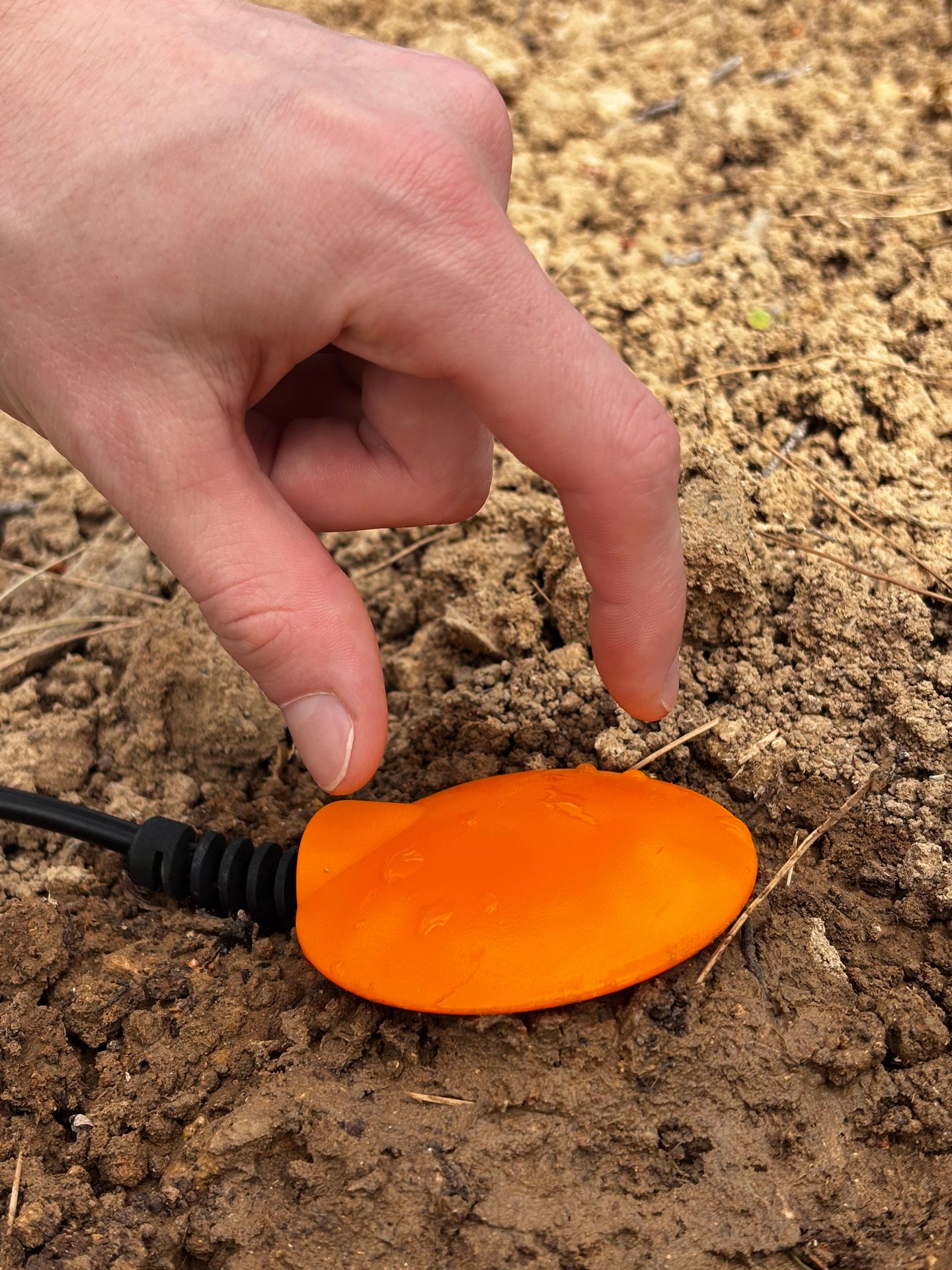
What is a capacitive probe?
A capacitive probe is a soil sensor that measures moisture. Its role is simple: to measure the amount of water present in the soil at a given moment, at one or several depths, known as horizons.
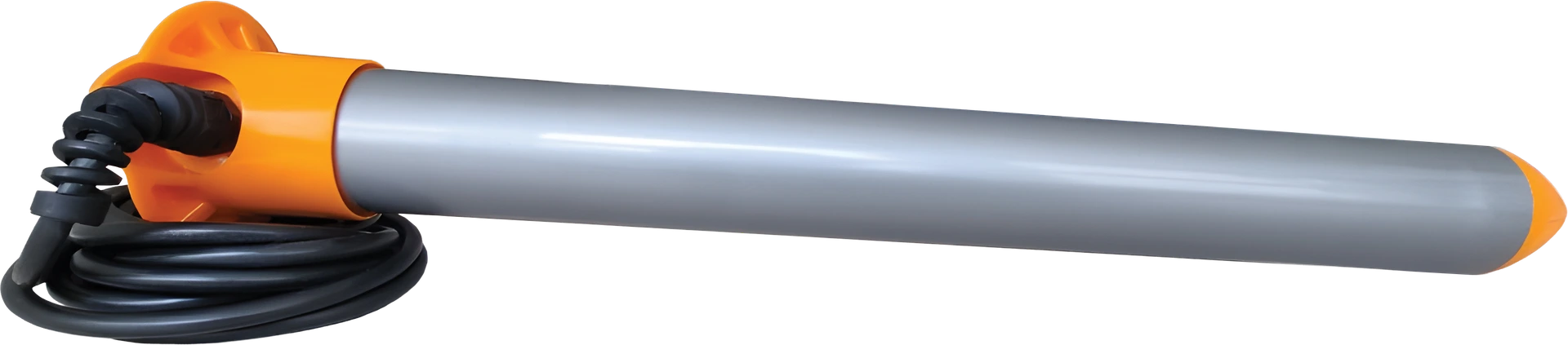
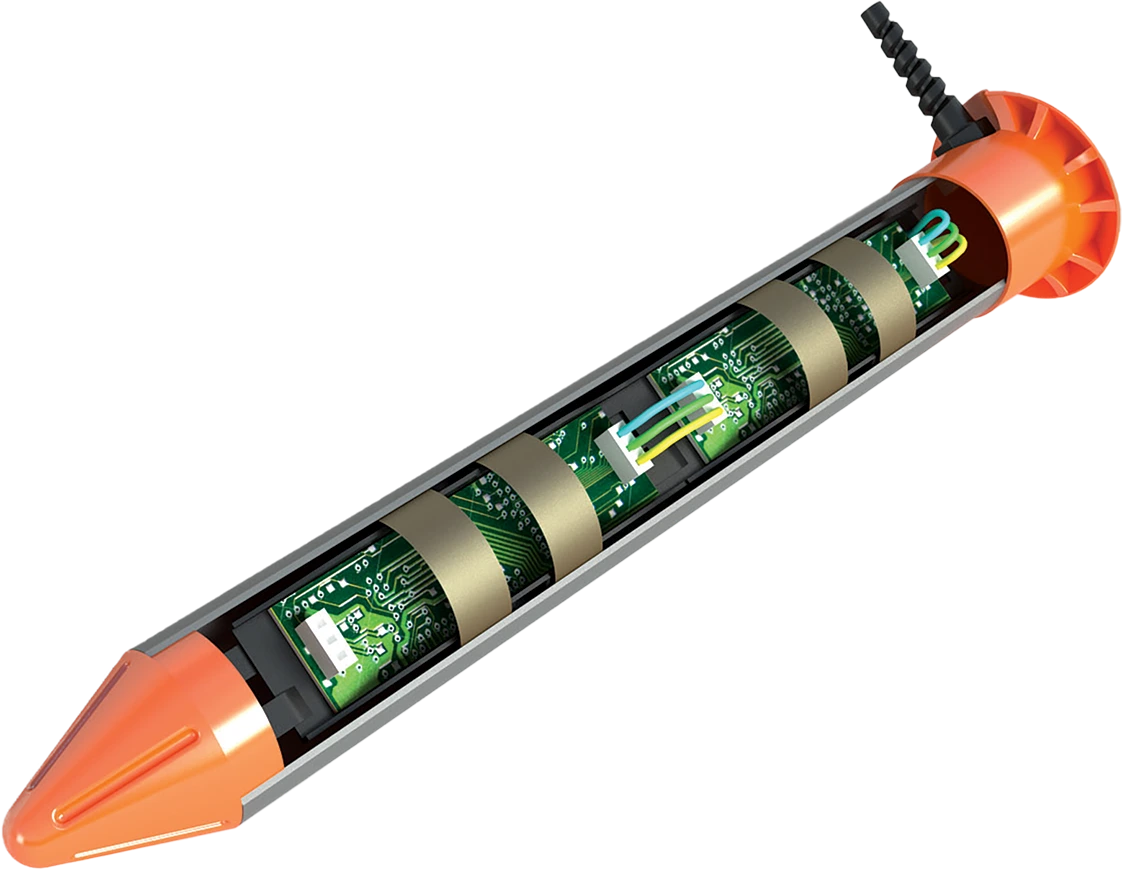
In practical terms, it takes the form of a tube inserted into the soil, within the root zone of your crops. At HSTI-France, our capacitive probes measure soil moisture and temperature levels, providing you with the information you need for well-informed irrigation decisions.
Once installed in your field, the probe is connected to a communication unit, also known as a datalogger, which continuously collects data from each probe and transmits it to a web-based monitoring platform or a decision-support tool.
In agriculture, it is used to fine-tune irrigation with precision. It can be found across a wide range of farming operations:
- Field crops (corn, sugar beet, potatoes…)
- Viticulture, where managing water stress is a genuine quality lever
- Orchards (apple, pear, hazelnut trees…)
- Vegetable crops, whether grown under greenhouse or in open fields
It's suited both to farmers just starting out with precision irrigation and to technicians and advisors supporting more complex operations.
In short: a capacitive probe is the "eyes" of your soil. It tells you what you can't see with the naked eye.
What is a capacitive probe used for in irrigation?
The primary purpose of a capacitive probe is to help you decide when to irrigate, how much water to apply, and when to stop.
Knowing when to actually irrigate
Without a soil sensor, you rely on concrete, legitimate indicators: the plant's visual appearance, weather data, the cropping calendar, your own knowledge of the land. These benchmarks carry real agronomic value, and farmers who use them aren't fundamentally wrong.
But they have one limitation: they offer an indirect or delayed picture of what's actually happening in the soil. Weather data tells you what has fallen, not what remains available to the plant.
Visual observation often comes into play once stress has already set in, since in most cases, the first effects of water stress aren't visible to the naked eye.
The capacitive probe doesn't replace these benchmarks, it complements them with direct information: the real water status of your soil, at the depth that matters for your crop, exactly when you need it. You keep your field expertise, and you add greater precision to it.
Monitoring Soil Moisture in Real Time
Until now, knowing your soil's water status meant heading out to the field, spade in hand, to observe and feel the earth. A useful method, but time-consuming and one that only gives you a snapshot at a single moment, at a single point.
With a capacitive probe connected to a datalogger, this information is automatically relayed on a continuous basis, 24/7. You can check it from your computer or phone, using the decision-support tool, without ever having to travel to the field.
On Odusol, our decision-support tool, you can visualize variations over time: the effect of rainfall on the soil profile, the crop's water consumption between two visits, the real impact of an irrigation event. These data points give you a dynamic reading of your soil and let you act at the right moment, making your decisions right from your computer or smartphone.
Fine-tuning water inputs with Precision
Too much water is just as much of a problem as too little. In the field, most irrigation mistakes come from poor timing rather than poor volume. In fact, it's one of the most common irrigation traps: over-irrigating out of caution, believing you're doing the right thing, when the soil is already sufficiently saturated.
Excess irrigation leads to a series of concrete consequences:
Drainage: once the available water capacity is reached, the soil can no longer hold any additional water. It drains down into deeper layers, below the zone explored by the roots. It's no longer available to the plant and represents a needless loss along with extra pumping costs.
- Leaching of inputs: fertilizers and crop protection products travel with the water toward deeper horizons, or even into the water table. This represents a financial loss and a direct impact on your business.
- Root asphyxiation in clay or poorly-drained soils: prolonged water excess deprives roots of oxygen and weakens the crop sometimes just as much as a water shortage and can lead to disease development.
The capacitive probe lets you visualize exactly where your soil stands before you irrigate. You know what's still available at each horizon, what's already been consumed by the crop, and what's been lost to drainage.
You apply exactly what the plant needs.
No more, no less.
And above all, at the right time.
Avoiding water stress and water waste
This is the fundamental double benefit of the capacitive probe: protecting the crop on one hand, preserving the water resource on the other.
Water stress, even moderate, has direct effects on yield and quality. In field crops, a poorly managed deficit during a critical period for example at corn flowering can cost several quintals per hectare. In viticulture, stress that's too pronounced or comes too late impacts ripeness and aromatic profiles. In arboriculture, it can cause fruit drop or sizing problems, affecting both the current year and the following one.
Over-irrigating doesn't just cost water it also costs energy. Every unnecessary irrigation cycle consumes electricity or fuel for pumping, prematurely wears out equipment, takes up work time, and generates additional operating costs. It also adds time to organizing irrigation rounds, requiring more planning, travel, and coordination to intervene at the right moment. In the end, just a few extra millimeters of water can represent tens, even hundreds of euros wasted per hectare over a season. At a time when energy is expensive and water resources are increasingly constrained, optimizing irrigation has become a genuine economic issue as much as an environmental one.
According to field monitoring conducted by HSTI-France between 2022 and 2025, water consumption reductions reach 20 to 30% on average, without any yield degradation—quite the opposite, in fact.
This gain has a simple explanation: our users no longer irrigate out of habit or caution, but when their soil actually needs it.
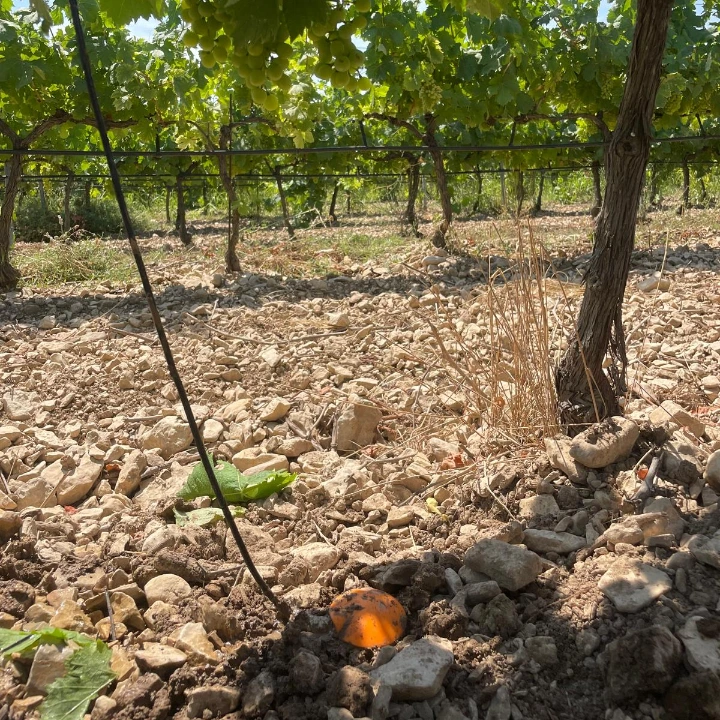
HydraScout capacitive probe installed in a vineyard plot for soil moisture monitoring
How does a capacitive probe work?
Rest assured, you don't need to be an engineer to understand the principle.
How a profile capacitive probe works
A capacitive probe is made up of several sensors distributed along a tube, called a profile probe. Each sensor emits an electromagnetic field around itself. This field explores the soil within a given radius: depending on the amount of water present, the returned signal is altered to a greater or lesser degree.
In simple terms: the probe sends an electrical signal into the soil and measures how the soil receives it. From this, it derives the water content. No moving parts, no mechanical wear it's reliable and built to last.
HSTI-France capacitive probes measure two parameters:
- Volumetric soil moisture (VWC) in %, the main data point for managing irrigation
- Soil temperature, useful for refining moisture calculations with precision and monitoring proper conditions for root development
Measuring at multiple depths: the real agronomic advantage
This is where the profile capacitive probe really comes into its own. Rather than measuring at a single point, it tracks moisture across the entire root profile simultaneously and continuously, at different depths in the soil.
At HSTI-France, our HydraScout and HydraSolo probes are available from 10 cm to 150 cm deep, with sensors positioned according to your needs and the rooting depth of your crops. A configuration adapted to every situation, whether it's a shallow-rooted annual crop or a vineyard whose roots explore deep horizons.
In practical terms, this multi-depth reading lets you distinguish between:
- the surface layer (10-20 cm), heavily influenced by weather and recent inputs
- the main root zone, the most strategic area for deciding when to irrigate
- Les horizons profonds où vous détectez un drainage excessif avant qu'il ne devienne un problème.
This complete, real-time view of the profile is something no visual observation or one-off measurement can offer you. You no longer manage your irrigation "blindly", you can see exactly what's happening in your soil, at every depth, at every moment.
How do you read data from a capacitive probe?
Having a probe in your soil is the first step, but knowing how to interpret the data is where it all comes together.
Raw moisture data doesn't speak for itself. To make good irrigation decisions, you need to be able to visualize it, understand it, and put it into context without spending hours on it. That's exactly the purpose behind our design of Odusol.
Odusol: your irrigation dashboard
Odusol is our decision-support tool (DST), available on web and mobile, which centralizes in real time all the data collected by your capacitive probes.
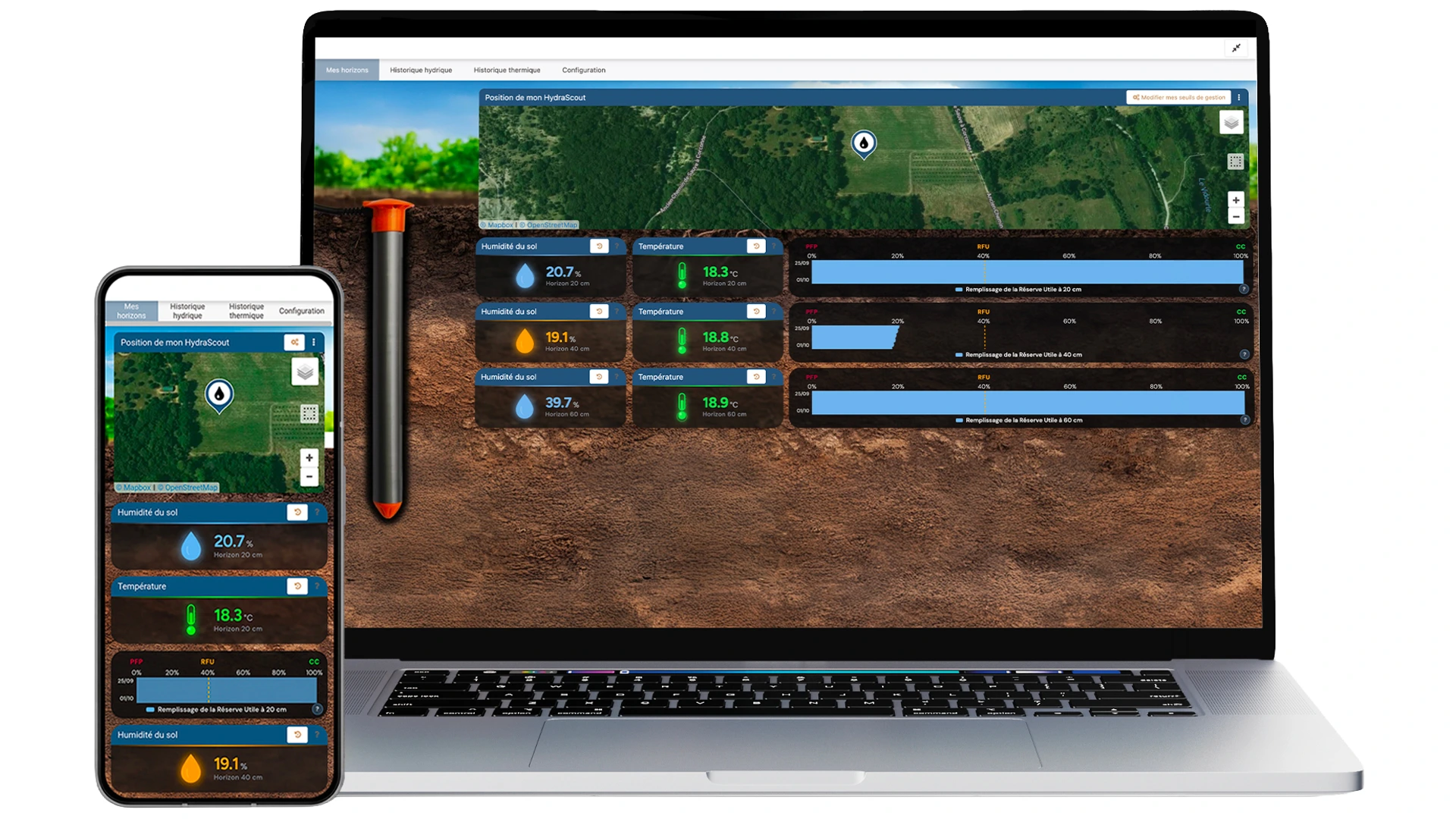
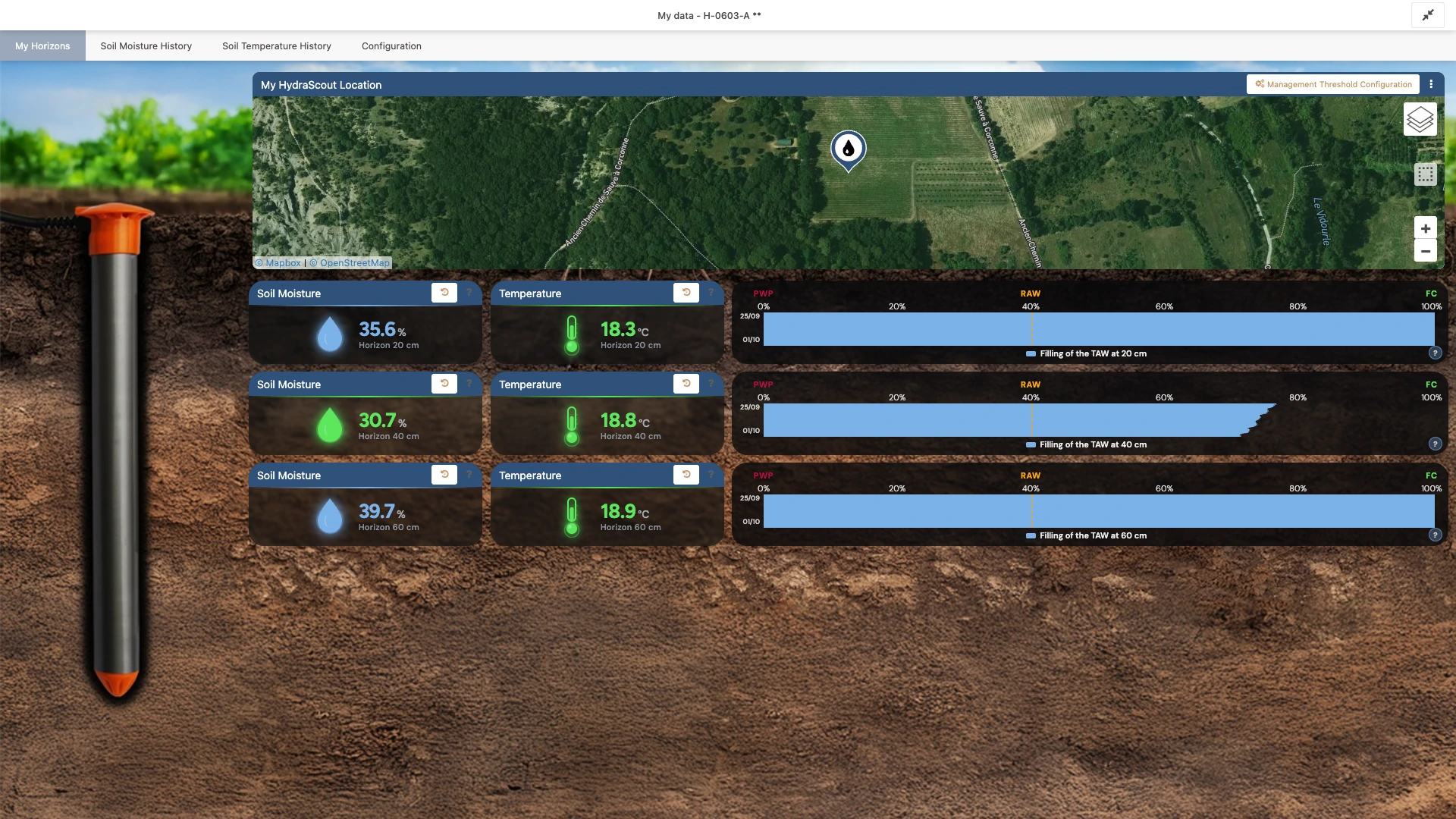
From a clear and accessible interface, you can:
- View moisture curves by soil depth, over the period of your choice
- Track the Plan Available Water and instantly see whether your crop is short on water or whether you've over-irrigated,
- Detect drainage as soon as it occurs, thanks to deep soil measurements
- Receive automatic alerts when critical thresholds are reached,
- Benefit from your advisor's recommendations, integrated directly into the tool because data alone isn't enough, human support makes the difference.
You're no longer just reading numbers. You're making informed decisions, at the right time, for the right crop.
Why choose a capacitive probe over another solution?
When looking to better manage irrigation, there's no shortage of options. Tensiometers, resistive probes, rain gauges… so why is the capacitive probe increasingly the choice of demanding farmers?
Precision that serves your decisions
The capacitive probe continuously measures the soil's volumetric moisture content, without interruption, without manual handling. Unlike the tensiometer, which requires regular maintenance and can become desaturated during dry periods, the capacitive probe remains reliable in all conditions, from spring through summer, regardless of soil tension..
Multi-depth monitoring, a true reflection of root behavior
This is one of its major strengths: measuring simultaneously at several depths (20, 40, 60, 80 cm, for example) makes it possible to understand exactly where the water sits in the profile, how the roots are using it, and at what point it starts to drain.
No other solution offers you such a complete view of your soil's behavior.
An agricultural soil sensor built to last
Rugged and permanently buried, the capacitive probe requires no daily intervention. Once installed, it works continuously, measuring changes in soil moisture and temperature and automatically transmitting the data to your management tool.
Unlike tensiometers, which measure the tension of water in the soil and require regular upkeep (refilling, checking proper soil contact, maintenance), the capacitive probe is free of these constraints. It directly measures the soil's water content that is, the actual volume of water present in the root zone.
This approach provides data that is more stable over time, less sensitive to variations in contact or handling, and above all much easier to use in a decision-support tool like Odusol. The information becomes directly actionable for managing irrigation with precision, without complex on-the-ground interpretation.
For which crops and which types of soil?
The capacitive probe isn't reserved for any one type of farming. It adapts to a wide variety of contexts, provided it's correctly positioned and properly interpreted.
Row crops: corn, wheat, sunflower…
In row crops, water needs are significant and irrigation windows are often short. A capacitive probe placed in the root zone lets you trigger irrigation at the right time neither too early nor too late and avoid unnecessary applications between rainfalls.
Example: on corn, a probe at 60 and 80 cm can detect depletion of the available water reserve before the crop enters water stress, anticipating visible signs by 24 to 48 hours.
Viticulture: irrigating precisely, without excess
Vines are sensitive. Too much water harms quality; too little weakens yield. The capacitive probe allows for fine-tuned control of drip irrigation, respecting key phenological stages such as fruit set or véraison.
Example: during a summer drought, a winegrower can track hour-by-hour water consumption across their plots and adjust inputs without risking washing out the aromas.
Tree fruit farming: roots to monitor in depth
Fruit trees have deep, complex root systems. With agricultural soil sensors positioned at multiple depths, it becomes possible to track deep recharge and detect drainage before it becomes a problem.
Example: on apple or peach trees, a probe at 50 to 80 cm reveals whether water is truly reaching the deep roots or evaporating at the surface.
Adapting to soil type
Every soil has its own characteristics:
- Sandy soil → fast drainage, low available water reserve → frequent, short irrigations
- Clay soil → high retention, risk of waterlogging → measured, spaced-out irrigation
- Loamy soil → intermediate behavior → regular monitoring recommended.
The capacitive probe, combined with a good understanding of your soil profile, lets you precisely adapt your precision irrigation strategy to the reality of your plot.
A simple solution to irrigate precisely, and save water, time, and energy
The capacitive probe is, above all, a tool for clarity. Clarity on the water status of your soils. Clarity on the right moment to irrigate. Clarity on what your crop truly consumes, day after day, depth after depth.
But technology alone isn't enough. It's the combination of a well-positioned probe, well-interpreted data, and human support that makes the difference in the field.
This is exactly the approach we offer at HSTI-France: the HydraScout and HydraSolo capacitive probes, connected to Odusol, our decision-support tool dedicated to irrigation management, with technical support to help you interpret your data and make the right decisions.
Key takeaways
If there's only one thing to remember:
Capacitive probes  et
et  measure soil moisture in real time, at one or several depths.
They allow you to irrigate at the right time, based on the crop's actual needs and the water available in the soil.
Capacitive probes limit water stress while reducing the waste of water, energy, and inputs.
Have questions?
Talk it over with an HSTI-France advisor